Safety comes before troubleshooting
If you smell gas, leave the house and call your gas utility or 911 from outside. Do not flip switches or look for the source. If a carbon monoxide alarm sounds, get everyone outside and call 911 first.
If the boiler is leaking heavily, shut off its power at the switch and close the water feed valve if you can reach it safely. Hot water and steam cause burns, and standing water near wiring is dangerous. Everything else in this guide assumes there is no gas smell and no active leak.
Check the simple things first
Many no-heat calls end with a quick fix. Make sure the thermostat is set to heat and above the room temperature, and replace its batteries if it uses them. Check that the boiler's power switch is on and that the breaker has not tripped.
Confirm the fuel supply. A gas boiler needs the gas valve open and the utility service active. An oil boiler needs fuel in the tank, and a clogged filter or a tripped safety reset can stop it. Press a reset button once only, since repeated resets can flood the burner.
- Thermostat mode and setpoint
- Power switch and circuit breaker
- Fuel supply and valve position
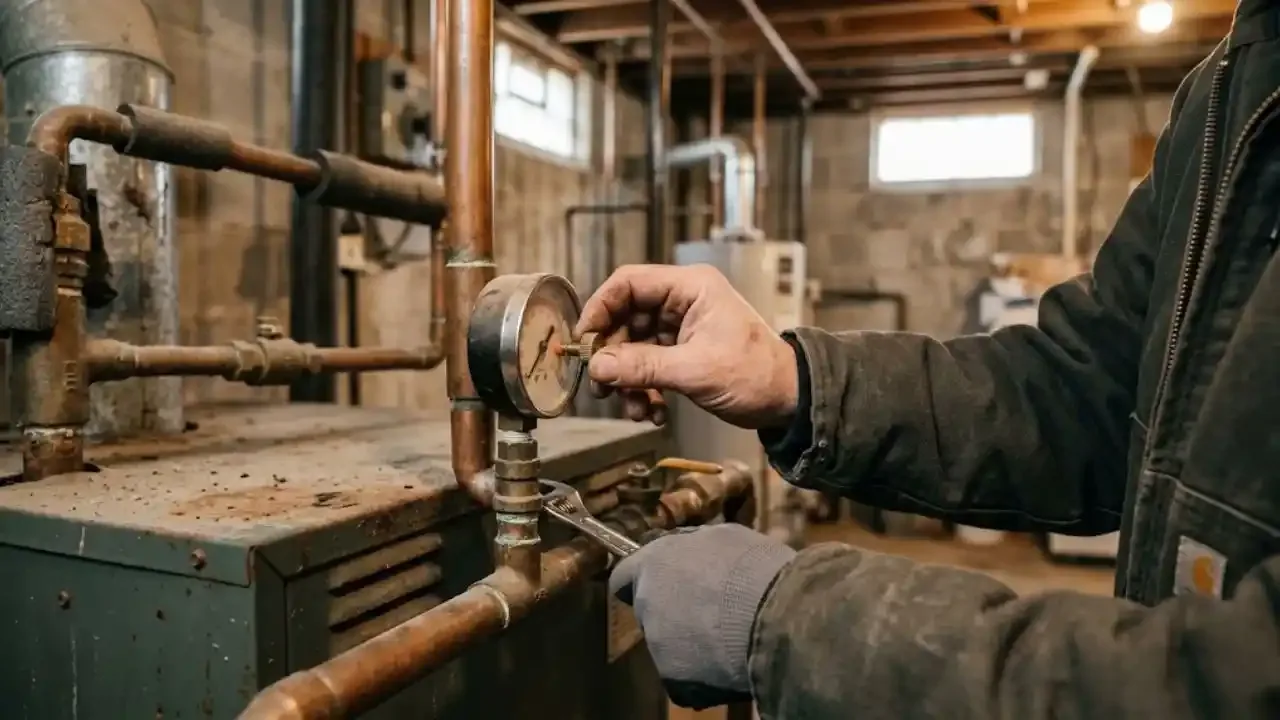
- Water pressure gauge in the normal range
Common boiler problems and what they mean
| Symptom | Likely cause | Who fixes it |
|---|---|---|
| No heat, no hot water | Failed ignition, tripped safety, no fuel | Plumber or heating technician |
| Banging or kettling noise | Mineral buildup or trapped air | Plumber |
| Water pooling underneath | Leaking valve, tank or fitting | Plumber, shut it down first |
| Pressure too low | Small leak or failed expansion tank | Plumber |
| Radiators cold at the top | Air in the system | Bleed valves, or a plumber |
| Pilot keeps going out | Dirty pilot or failed thermocouple | Licensed professional |
Low pressure and leaks
Most hot water boilers run between 12 and 15 psi when cold, but the gauge on your unit and its manual are the authority. If the pressure sits at zero, the system is losing water somewhere. That could be a visible drip or a slow leak inside a wall or under a floor.
A boiler that needs frequent refilling is telling you something. The fix is finding the leak, not topping it off. Topping off adds fresh water and fresh oxygen, which speeds corrosion inside the system and shortens its life.
Noise: banging, kettling and gurgling
Banging and rumbling, sometimes called kettling, usually mean scale or sludge on the heat exchanger, so water boils in pockets instead of flowing evenly. A professional flush or cleaning clears it. Gurgling and hissing in radiators usually mean trapped air, which a bleed valve can release.
Do not ignore persistent noise. It wastes fuel and can damage the heat exchanger, which is among the most expensive parts of the whole unit.
Sandwich details: gas, permits and licenses
Natural gas customers on the Cape are served by National Grid, according to the Cape Light Compact. For gas smell, call your gas utility or 911 from outside and do not rely on a plumber for that emergency.
In Massachusetts, plumbing and gas work is licensed. The state's Board of State Examiners of Plumbers and Gas Fitters licenses plumbers, and permits for plumbing work are issued only to licensed plumbers. You can verify a license through the state's eLIPSE portal. The Sandwich Building Department handles plumbing and gas permits and inspections, with inspections held on Mondays, Wednesdays and Fridays, booked by phone. Ask the Sandwich Building Department whether your boiler job needs a permit.
Our team also serves nearby towns, including Mashpee and Bourne, where the local building department handles its own permits.
Source: Town of Sandwich Building Department and Mass.gov plumbers and gas fitters board
Boiler down and the house is cold?
Call the line. A plumber can talk through the symptoms and set up a visit.
Repair or replace?
A boiler can run for decades with care, so age alone is not a reason to replace it. The question is the cost and frequency of repairs. A single failed part on an otherwise sound unit is a repair. A cracked heat exchanger, repeated leaks or constant parts failures often point to replacement.
Ask for a clear price and a straight opinion. A good technician will tell you when a repair makes sense and when it only delays the inevitable. See our boiler repair page for how we approach a diagnosis.
Steam, hot water and the questions to ask
Boilers come in two broad types. Hot water systems pump heated water through pipes to radiators or baseboards. Steam systems boil water and send the steam up to radiators. They fail in different ways, and a technician who knows both will ask which type you have before anything else.
Before the visit, write down the make and model on the label, the symptoms and when they started. Note any error code on the display and the pressure on the gauge. This saves time and often lets a plumber arrive with the right parts.
Ask what the diagnosis fee covers and whether it applies to the repair. Ask for the price in writing before parts are ordered. If the answer is a replacement, ask what failed, what the alternatives are and what the new unit would cost to run compared with the old one.
Preventing a winter breakdown
Have the boiler serviced once a year before the heating season. Service includes cleaning, testing safety controls and checking combustion. Keep the area around it clear of storage, and make sure carbon monoxide alarms are working on every level.
Know where your shutoff valves and breaker are before you need them. In an emergency you will not want to look for them in the dark.
Finally, keep a short log of what happens and when. Note the date of each service, any parts replaced and any odd behavior, such as short cycling or a delay before the burner lights. A written history helps a technician spot patterns, and it helps you decide when a repair bill has become a reason to replace the unit.
Frequently asked questions
Usually scale or sludge on the heat exchanger or trapped air. A cleaning or flush often solves it.
Once a year, before the heating season, is the standard advice.
A heavy leak is. Turn off power to the unit, close the water feed if it is safe, and call a plumber right away.
Yes, with a radiator key and a towel. Open the valve slowly until water appears, then close it. Check the pressure gauge afterward.
Leave the house, then call your gas utility or 911 from outside. Do not turn anything on or off inside.
The Sandwich Building Department handles plumbing and gas permits and inspections. Ask whether your specific job needs one.
Still have a question about your situation? The line is open around the clock.
Call (508) 389-4045Standards note: gas piping on a boiler must be handled by a licensed gas fitter under the state standard, 248 CMR 10.00. Ask the Town of Sandwich Building Department about inspections.