A Hidden Leak Is Costing You Money Right Now
If you hear water running when nothing is on, see a stain spreading on a ceiling, or find a wet patch in the yard, call now. A leak you cannot see keeps running day and night, and the longer it runs the more damage and the higher the bill.
Leak detection is the work of finding where the water is escaping without tearing open everything. A plumber who guesses opens the wrong wall. One who tests narrows it down first. That difference is the point of this service.
Emergency Leak Steps You Can Take In Five Minutes
These steps confirm whether you have a leak and shut off the water if it is serious.
Turn everything off
Close taps, stop the dishwasher and washer, and make sure no one is using water.
Read the meter
Find the water meter, note the reading or watch the small flow indicator. Wait fifteen minutes with nothing running and look again.
Spot the movement
If the indicator moves or the numbers change, water is leaking somewhere on your side of the meter.
Shut the main
If you cannot find the leak or water is spreading, close the main shutoff valve and call right away.
Signs Of A Leak You Might Be Missing
| What you notice | What it can mean |
|---|---|
| Bill higher than usual with no change in habits | Leak in a fixture, a service line or an irrigation line |
| Sound of running water at night | Leak in a supply line or a running toilet |
| Warm spot on a floor | Leak in a hot water line under a slab |
| Musty smell, peeling paint or bubbling drywall | Leak inside a wall or ceiling |
| Unexpected green, lush patch in the lawn | Leak in a buried line |
| Low water pressure everywhere | Leak in the service line or main supply |
How We Find A Leak Without Opening Everything
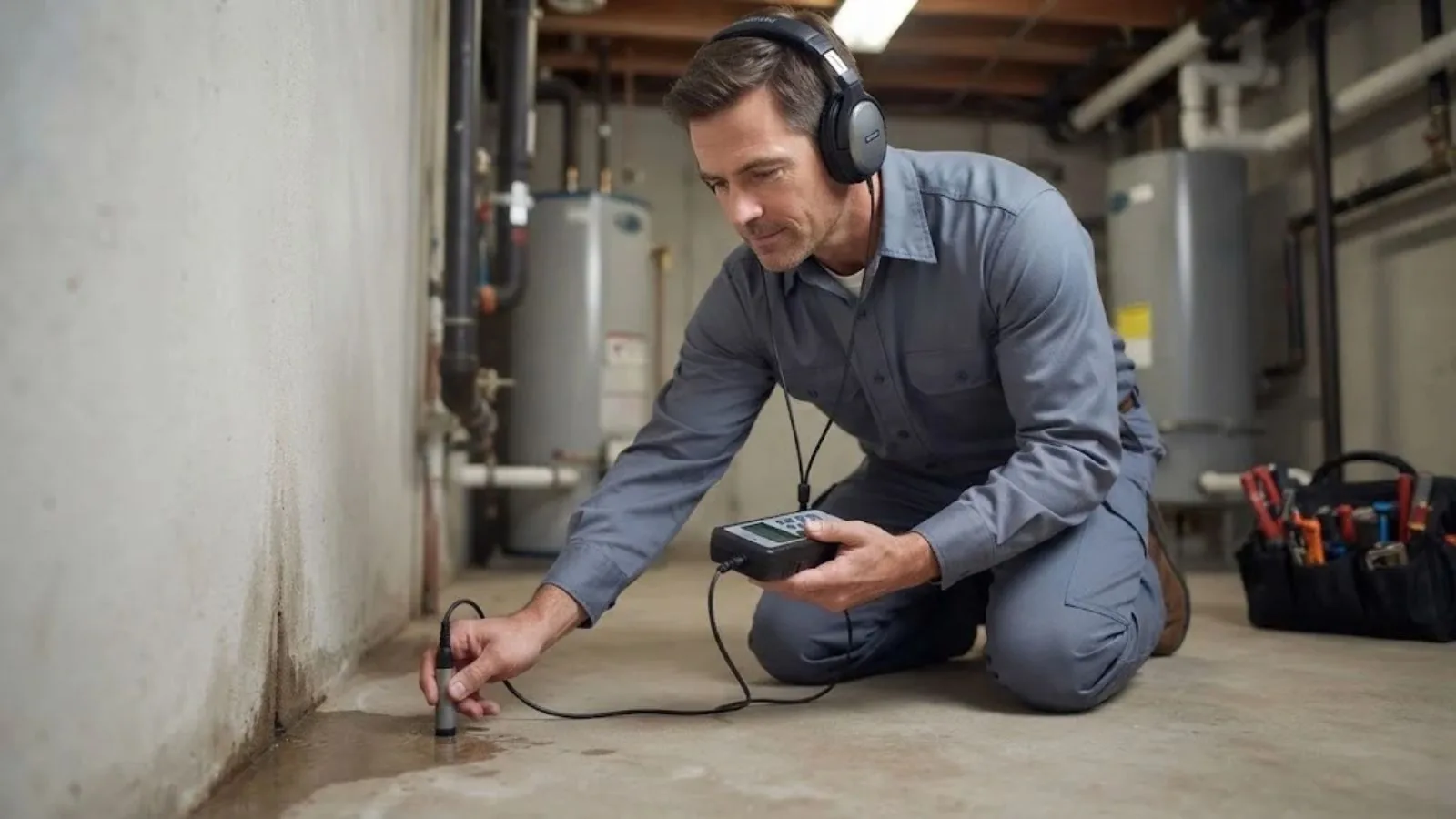
We start with a pressure and flow test to confirm the leak and see which part of the system it is in. From there the tools narrow the search. Each one answers a different question, and we use the ones that fit your home.
Acoustic listening
Sensitive microphones pick up the sound of water escaping from a pressurized pipe. The sound is strongest closest to the leak, which narrows the search to a few feet.
Thermal imaging
A thermal camera shows temperature differences on walls and floors. A hot water leak or damp insulation stands out from the dry areas around it.
Moisture mapping
A moisture meter traces how far dampness has spread through drywall, wood and subfloor so we know the real size of the problem.
Pressure isolation
We close off sections of the system one at a time and watch the pressure. When the pressure holds, that section is cleared.
Camera inspection
For drain and sewer leaks, a camera on a cable travels through the line and shows cracks, offsets and root entry. See sewer inspection for details.
Slab Leaks And Under-Floor Leaks
A leak under a concrete slab is the hardest to find and the easiest to ignore. Warm spots on the floor, the sound of running water and a bill that climbs are the usual signs. Detection pins the leak to a small area so that the fix opens a small patch of floor instead of a whole room.
Once the location is known, there are several options. Spot repair fixes the broken section. Rerouting the line through walls or ceiling bypasses the slab entirely. Repiping the affected section makes sense when the old pipe is failing in several places. See repiping for whole-line replacement.
Leaks Outside The House
A leak between the street and your house is on the water service line. These leaks hide underground, and the first sign is often a wet spot in the yard, a drop in water pressure or a bill that does not match your use. Irrigation lines are another common source, especially after a winter when frozen ground has shifted pipe.
If the leak is on the buried supply line, the fix is covered under water service line repair and replacement. Which part of the line is yours and which belongs to the utility is something to confirm with the water district before digging starts.
What Drives The Price Of Leak Detection
What changes the price of finding a leak
Detection is priced by the time and equipment needed. You get a clear number before the work begins.
Where the leak might be
A leak in an accessible wall is faster to find than one under a slab or in a buried line.
Which tools are needed
Acoustic, thermal and camera methods each add setup and time.
Size of the property
A larger home or a long service line means more pipe to test.
Repair work that follows
Detection finds the leak. Fixing it is priced separately once you know what it takes.
Time of the call
Evening and weekend visits are emergency visits and are priced that way.
A note on insurance
Insurers often cover sudden pipe bursts but treat long-running leaks as maintenance. A written record of where and when we found the leak can help your claim.
Leak Detection In Sandwich
In Sandwich, municipal water comes from the Sandwich Water District, which draws on groundwater wells and also buys water from the Upper Cape Regional Water Supply Cooperative. The district keeps staff on call around the clock for utility-side emergencies. A leak on the street side of your meter is theirs to handle, and a leak on the house side is yours.
Many Sandwich homes also use private irrigation lines and outdoor spigots that run through a Cape Cod summer. Those lines sit shallow and take the brunt of frost heave. If your bill spikes in warm months, an irrigation leak is a good first suspect. Ask the district how your meter is read and billed, then compare that against what we find.
Source: Sandwich Water District 2025 Water Quality Report and district contact information.
The Small Leaks That Add Up
Not every leak is hidden in a wall. A toilet that runs after flushing can waste a surprising amount of water in a day without making any noise you notice. A drip at a faucet or a weeping shutoff valve under a sink does the same quietly.
To test a toilet, add a few drops of food coloring to the tank and wait twenty minutes without flushing. If color appears in the bowl, the flapper is leaking. Many of these are quick repairs, covered under toilet repair and faucet repair.
If you have checked the fixtures, the meter still moves and the damp spot has no obvious source, that is the sign to call for detection.
What Happens After We Find It
Once the leak is located, we show you what we found and what it takes to fix. If the repair is simple, we can often do it in the same visit. If it needs an opening in a wall or floor, we tell you where it will be and how large.
We also look at why the leak happened. A failed fitting is a one-time repair. Corroded pipe that is failing in several places is a different story, and we say so plainly so you can plan.
Frequently asked questions
It is when water is spreading, a bill has spiked, or you hear running water with everything off. Shut the main if water is visible, then call.
Turn off every fixture, then watch the meter for fifteen minutes. If the small indicator moves or the numbers rise, water is leaking on your side of the meter.
Yes. Acoustic listening and thermal imaging usually narrow a slab leak to a small area, so the repair opens a small section of floor.
We try not to. Detection tools show where to open, and we open the smallest area we can. If a wall must be opened, we tell you before we cut.
It depends on where the leak is. Ask the Sandwich Water District which part of the line belongs to you before any digging starts.
The usual causes are a running toilet, a dripping fixture, an irrigation leak or a leak in the buried service line. A meter test narrows it down quickly.
Yes. Persistent dampness in walls and floors can lead to mold, so dry the area and fix the source quickly.
Yes. Detection and repair are separate steps, and you see the cost of the repair before it starts.
Still have a question about your situation? The line is open around the clock.
Call (508) 389-4045Reference: according to the Cape Cod Commission, Cape Cod sits on a sole source aquifer, which is why a hidden leak here is both a property problem and a water-use problem. Repairs follow 248 CMR 10.00.