Sewage In The House Is An Emergency
If sewage is coming up through a floor drain, a tub or a toilet, call now. Raw sewage in a living space is a health hazard, and a damaged line will keep backing up until it is fixed. Stay out of the affected area and keep children and pets away.
A sewer line problem is different from a drain clog. A clog can be cleared. A crack, a collapsed section or a root-filled joint keeps coming back unless the pipe itself is repaired. Our job is to work out which one you have, and the camera is how we do it.
Emergency Sewer Backup: Steps To Take Right Now
Stop using water
Do not flush, run the washer or use sinks. Every drop goes into a line that cannot carry it.
Keep clear of the area
Avoid contact with standing sewage. Wear boots and gloves if you must enter, and wash well afterward.
Protect electrics
If water is near outlets or appliances, shut off power only if you can reach the panel from a dry spot.
Photograph the damage
Take photos before cleanup. They help with an insurance claim.
Signs Your Sewer Line May Be Damaged
A damaged line gives warnings before it fails completely. Spotting them early can turn an emergency into a planned repair.
| Sign | What it can mean |
|---|---|
| Slow drains in several fixtures | Partial blockage or a damaged section in the main line |
| Gurgling toilets or tubs | Air trapped by a clog or a collapsed section |
| Sewage smell inside or outside | Crack, broken joint or dry trap |
| Wet or sunken patch in the yard | Broken pipe leaking into the soil |
| Repeat clogs after clearing | Roots, offset joints or a belly in the pipe |
| Rodents or insects entering from drains | A breach in the line |
Finding The Problem With A Camera
We do not guess where a sewer line has failed. A waterproof camera on a flexible cable runs through the line and records what it sees. The video shows cracks, offsets, roots, corrosion and bellies, and a locator tells us how deep the pipe is and where it sits in the yard.
That information decides everything. It tells us whether a small section needs fixing or the whole run, how deep and how long the excavation would be and whether a trenchless method will work. For a camera inspection by itself, see sewer inspection.
Repair Options: From Spot Fix To Full Replacement
Repair a section
- Best when damage is limited to one joint or a short stretch
- Smaller excavation, quicker work
- Rest of the line must be in sound condition
- Lower cost when it fits
Replace the line
- Best when the pipe is failing in several places
- Handles collapsed, crushed or heavily rooted pipe
- Gives a continuous new pipe with proper slope
- Higher cost but a longer-lasting result
Trenchless methods
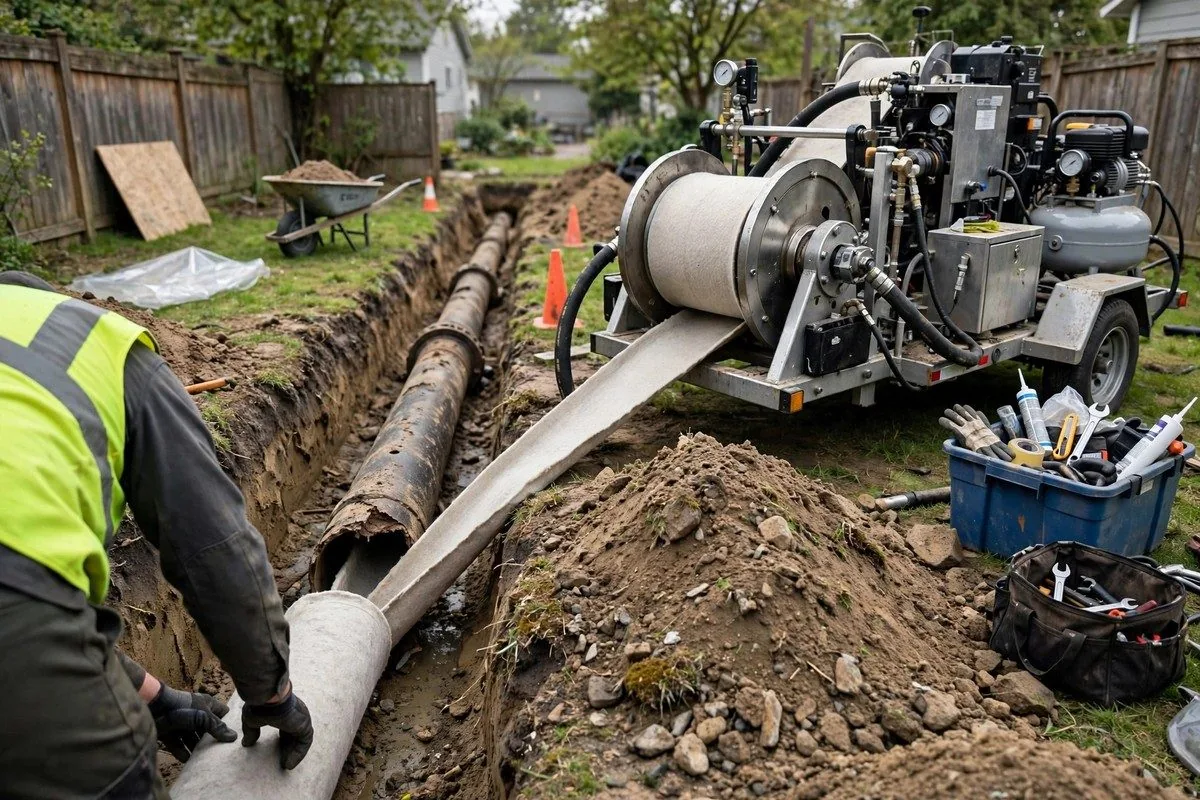
In some cases we can fix a line without digging a long trench. Pipe lining inserts a resin-coated sleeve that hardens inside the old pipe. Pipe bursting pulls a new pipe through the old one while breaking it apart. These methods work when the existing pipe is not too badly collapsed, and the camera tells us whether they will work for you.
Where the pipe has collapsed or has a serious belly, traditional excavation is usually the better answer, because the new pipe has to be set at the right slope on firm bedding.
Roots, Bellies And Old Pipe Materials
Tree roots are drawn to the moisture and nutrients in a sewer line. They enter through tiny cracks or loose joints and grow into a mass that catches paper and waste. Cutting the roots clears the line for a while, but unless the joint is repaired the roots return.
A belly is a low spot where the pipe has settled. Water and solids collect there, and the line clogs repeatedly. Cast iron lines corrode and flake inside. Clay pipe cracks at joints. Fiber conduit, sometimes called Orangeburg, softens and deforms. If your house is older, the camera will tell us which material you have and how much life it has left.
What Drives The Price Of Sewer Line Repair
What changes the price of a sewer repair
Sewer work depends heavily on the line itself. You get a clear price after the camera inspection and before the repair begins.
Length of the damage
A single spot repair costs far less than replacing the whole run.
Depth of the pipe
Deeper pipe needs a bigger excavation and more shoring.
Trenchless or open trench
Lining and bursting cost differently from digging, and not every line qualifies.
What is above the pipe
Driveways, patios, trees and landscaping add restoration work.
Permit and inspection
Sewer work usually has a permit and inspection step that is part of the job.
Time of the call
Emergency visits outside normal hours are priced as emergency visits.
A note on insurance
Sewer backup coverage is often an optional add-on to a homeowners policy, and not all policies include it. Check your policy before cleanup, and keep photos and receipts.
Sewer Lines In Sandwich: Public Sewer Or Septic
Before any repair, it matters whether your home is on a public sewer or a private septic system. The Town of Sandwich website does not state sewer coverage on its Water and Wastewater page, so ask the Sandwich Health Department whether your street has sewer or a Title 5 septic system. The answer changes what a failing line means and who has to approve the work.
Septic systems are governed by Title 5 of the State Environmental Code, 310 CMR 15.000, and Title 5 requires inspection under certain circumstances. Plumbing work on the house side is governed by the Massachusetts Uniform State Plumbing Code, 248 CMR 10.00, and permits are issued only to licensed plumbers. Ask the Sandwich Building Department about your repair.
Cape Cod sits on a single aquifer that is the source of all its drinking water, designated by the EPA as a sole source aquifer. That is one more reason a leaking sewer or septic line is worth fixing promptly.
Sources: Town of Sandwich Health and Building Departments, Mass.gov Title 5 information, Cape Cod Commission.
What Happens On The Day
We arrive, listen to what you have seen and get the camera in. If the line is blocked, we clear it enough to run the camera, then record the video and show you what we found.
If the repair is a spot fix, we mark the location, dig and replace the section. If it needs replacement, we lay out the route, explain restoration and schedule the work. Utility locating comes first, because digging without it is neither safe nor legal. We leave the site safe and tidy.
Before we close out, we run water through the new section and confirm it drains freely, then give you the camera footage and a plain summary of what was done. If an inspection is required, we coordinate it so the trench is not backfilled before it is signed off.
Frequently asked questions
Yes. Raw sewage in the house is a health hazard and the line will not fix itself. Stop using water, keep clear of the area and call.
A camera inspection shows the inside of the pipe. A clog is a blockage in a sound pipe. Damage shows as cracks, offsets, roots in the joints or collapsed sections.
Not always. Many repairs are a short excavation at the failed spot, and some can be done by trenchless methods. The camera tells us which applies to you.
Yes, roots can be cut out and the line cleared. But the roots return unless the joint they entered is repaired or the pipe is relined or replaced.
Ask the Sandwich Health Department whether your street has sewer or a Title 5 septic system. Your property records and a look for a septic tank cover can also help.
Coverage varies. Backup damage is often an optional add-on, and repair of a worn-out line is often not covered. Check your policy.
Usually yes. Ask the Sandwich Building Department. In Massachusetts, plumbing permits are issued only to licensed plumbers.
Yes. We often clear the line enough to run a camera, then decide. See sewer line cleaning for clearing without repair.
Still have a question about your situation? The line is open around the clock.
Call (508) 389-4045Reference: sewer and building drain work must meet the state standard, 248 CMR 10.00. If your home is on septic rather than town sewer, Title 5 (310 CMR 15.000) applies. Ask the Sandwich Board of Health or Building Department which rules affect your address.