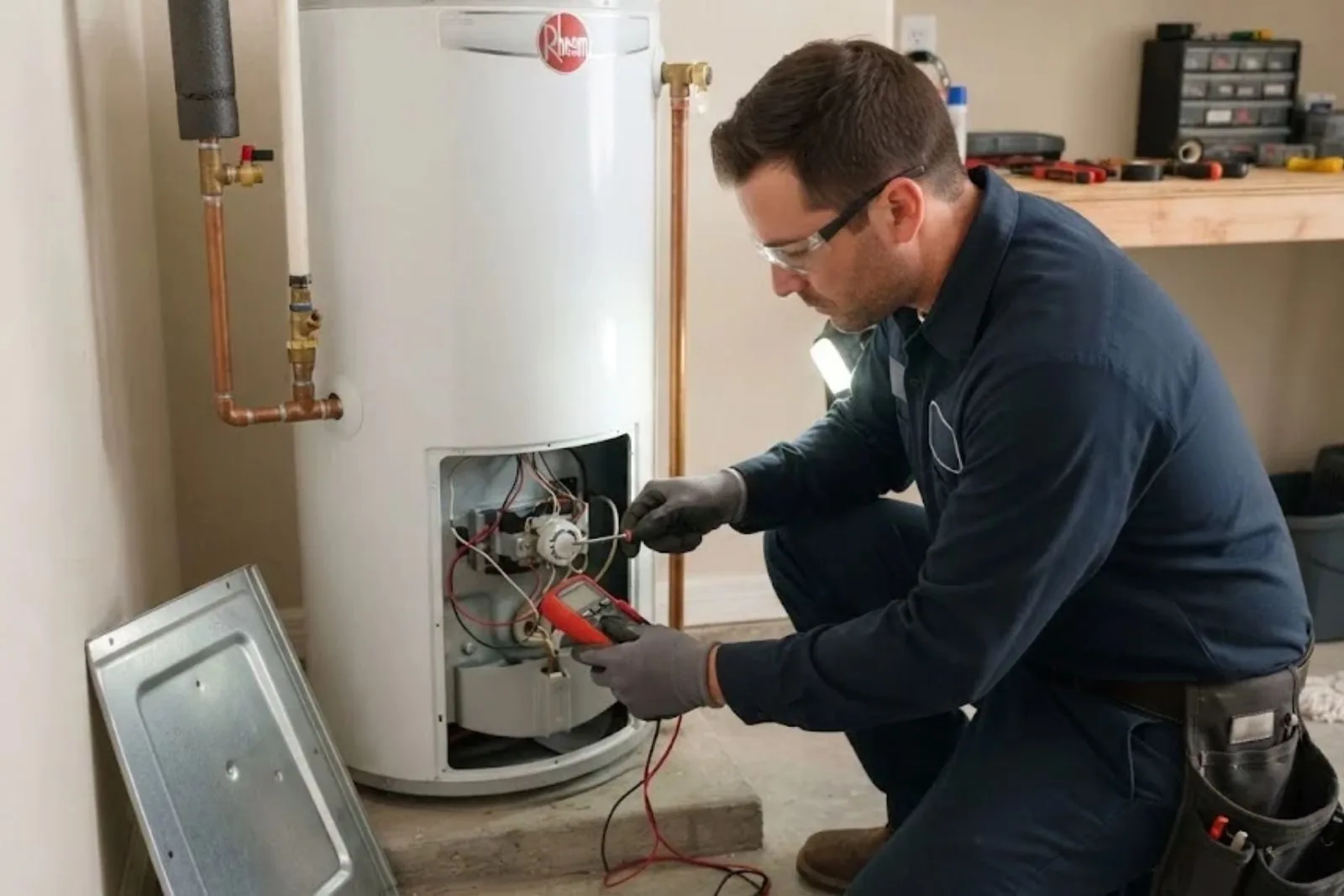
If The Tank Is Leaking, Act Before You Diagnose
If water is pooling around the base of your water heater, call now. A leak from the tank body is not a repair job, but a leak from a fitting, valve or drain can be fixed in a single visit, and the first thing that matters is limiting the damage.
No hot water at all is urgent in a different way. Sandwich winters are cold, and a house with no hot water and no heat from a related boiler problem needs quick attention. We start by working out whether this is a simple part failure or a sign the whole unit is finished.
Emergency Steps Before The Plumber Arrives
Shut the water supply
Close the cold water valve on the pipe above the heater. Turn the handle until it stops.
Cut the fuel or power
For electric units, switch off the dedicated breaker. For gas units, turn the gas control to pilot or off.
Do not touch wet wiring
If the floor around an electric heater is wet, stay out and shut off power at the panel from a dry spot.
Protect belongings
Lift boxes and stored items off the floor. A hose from the drain valve to a floor drain can reduce pooling.
Common Water Heater Problems We Diagnose
Most heater failures fall into a short list. Knowing which one you have tells you whether repair or replacement makes more sense.
| What you notice | Common cause | Typical outcome |
|---|---|---|
| No hot water, electric unit | Failed heating element or thermostat | Repair, usually same visit |
| No hot water, gas unit | Pilot, thermocouple or gas control fault | Repair, usually same visit |
| Hot water runs out fast | Sediment, broken dip tube or one failed element | Repair or flush |
| Rumbling or popping | Sediment hardened on the tank floor | Flush, or replace if old |
| Water at the tank base | Fitting, valve or the tank body | Repair if a fitting, replace if the tank |
| Rusty hot water | Corroded tank or anode rod gone | Evaluate, often replace |
Electric Units
Electric heaters have two heating elements and two thermostats. If you get lukewarm water, one element has usually failed. If you get none, the upper element, the upper thermostat or the high limit reset has tripped or died.
Elements and thermostats are inexpensive parts, and swapping them is often a fast repair. Before we replace anything we test with a meter, because a tripped breaker or a loose connection can mimic a dead element.
Gas Units
Gas water heaters add venting and combustion to the list of things that can fail. A pilot that will not stay lit often points at a worn thermocouple. A burner that lights then shuts off can mean a dirty burner, a weak draft or a failing gas control.
If you ever smell gas, leave the house and call your gas utility or 911 from outside. Do not turn on lights or try to relight the unit. For routine failures, we check venting, combustion air and the gas connection as part of any repair.
Tankless Units
Tankless heaters bring their own failures. Error codes, ignition faults, scale on the heat exchanger and clogged inlet screens are the usual causes. Many problems clear with a descaling flush, which is why routine service matters on these units.
If you own a tankless heater and the flow is weak or the water turns cold midway through a shower, call and describe what the display says. See our tankless water heater service page for maintenance details.
Repair Or Replace: How We Decide
We give you both numbers when it is a close call and let you decide. If replacement is the answer, see water heater replacement for what that involves.
Repair makes sense when
- The leak is at a fitting, valve or drain and not the tank body
- A single part such as an element, thermostat or thermocouple has failed
- The tank is otherwise sound and the unit is not near the end of its life
- The repair costs a small fraction of a new unit
Replace makes sense when
- The tank body is leaking or visibly corroded
- Repairs keep stacking up on an older unit
- Rusty water points to a tank that is failing inside
- A new unit would cut your recurring repair calls
What Drives The Price Of Water Heater Repair
What changes the repair price
A repair is priced by the part and the labor. You hear the price before work starts.
The part that failed
An element or thermostat costs far less than a gas control valve or a tankless circuit board.
Fuel type
Gas repairs include venting and combustion checks that electric repairs do not.
Unit age and model
Older units may need harder-to-find parts, and some are not worth repairing.
Access
A heater in a tight closet or crawl space takes longer to work on than one in an open basement.
Time of the call
Emergency evening and weekend visits are priced as emergency visits.
A note on insurance
Sudden water damage from a tank failure may be covered by a homeowners policy, though gradual leaks usually are not. Ask your insurer, and photograph the damage before cleanup.
Water Heaters In Sandwich Homes
Sandwich draws its drinking water from groundwater wells run by the Sandwich Water District. The district reports that it adds sodium hydroxide at its wells and booster station to control corrosion of household plumbing. That is a treatment choice aimed at your pipes and fittings, and it is worth knowing when you ask how long a tank might last.
Water chemistry is only one factor in how long a heater lasts, and the district's 2025 report does not give a hardness figure. If you want to know more about the water at your tap, ask the Sandwich Water District, or test it yourself. Tell us what you find and we will factor it into whether to repair or replace.
Source: Sandwich Water District 2025 Water Quality Report.
What Happens On The Visit
We arrive, confirm the fuel type and look over the unit before touching anything. Then we test, because a guess costs you money. On electric units that means checking power at the panel and testing elements and thermostats with a meter. On gas units it means checking the pilot, the gas supply, the venting and the burner.
Once we know what failed, we explain it in plain words and give the price for the repair. If the unit is past saving, we say so and walk through replacement options. Nothing starts until you agree, and the area is cleaned up when we finish.
If a leak has already done damage, we shut the unit down safely and show you where the water went so you can document it for your insurer.
Routine Care That Extends A Heater's Life
Test the temperature and pressure relief valve once a year by lifting the lever briefly. Water should flow and stop cleanly. If it drips afterward or does not flow, the valve needs replacing.
Flushing the tank clears sediment that hardens into a crust and makes the burner or elements work harder. On tankless units a descaling flush does the same job. Set the thermostat no higher than needed, because hotter water wears the tank and the fittings faster.
Frequently asked questions
Yes if water is spreading across the floor or the leak is from the tank body. Shut the cold water supply and power, then call. A slow drip from a fitting is still worth attention the same day.
On electric heaters the cause is usually a tripped breaker, a failed element or a bad thermostat. On gas units, check the pilot and gas supply. If the basics look fine, call and we will diagnose it.
Rumbling and popping usually mean sediment on the tank floor. A flush can quiet it, but on an older tank it may signal that replacement is coming.
Dry the area, then watch where the first drops appear. Drips at a fitting, valve or drain point to a repairable leak. Water appearing from the tank jacket or the base usually means the tank itself has failed.
Yes. Most tankless problems are scale, a blocked inlet screen or an ignition fault, and many clear with descaling or a part swap.
Simple like-for-like repairs normally do not. If the job involves replacing the unit or changing gas piping, ask the Sandwich Building Department, because plumbing permits are issued only to licensed plumbers.
Leave the house right away and call your gas utility or 911 from outside. Do not use switches or phones inside. Do not try to relight the pilot.
Leaks from the tank body, a gas smell, a relief valve that keeps discharging and any sign of overheating are urgent. Call right away.
Still have a question about your situation? The line is open around the clock.
Call (508) 389-4045Reference: according to the Massachusetts plumbing code, 248 CMR 10.00, water heater work is regulated plumbing and gas work. You can confirm any installer's license through the Board of State Examiners of Plumbers and Gas Fitters.