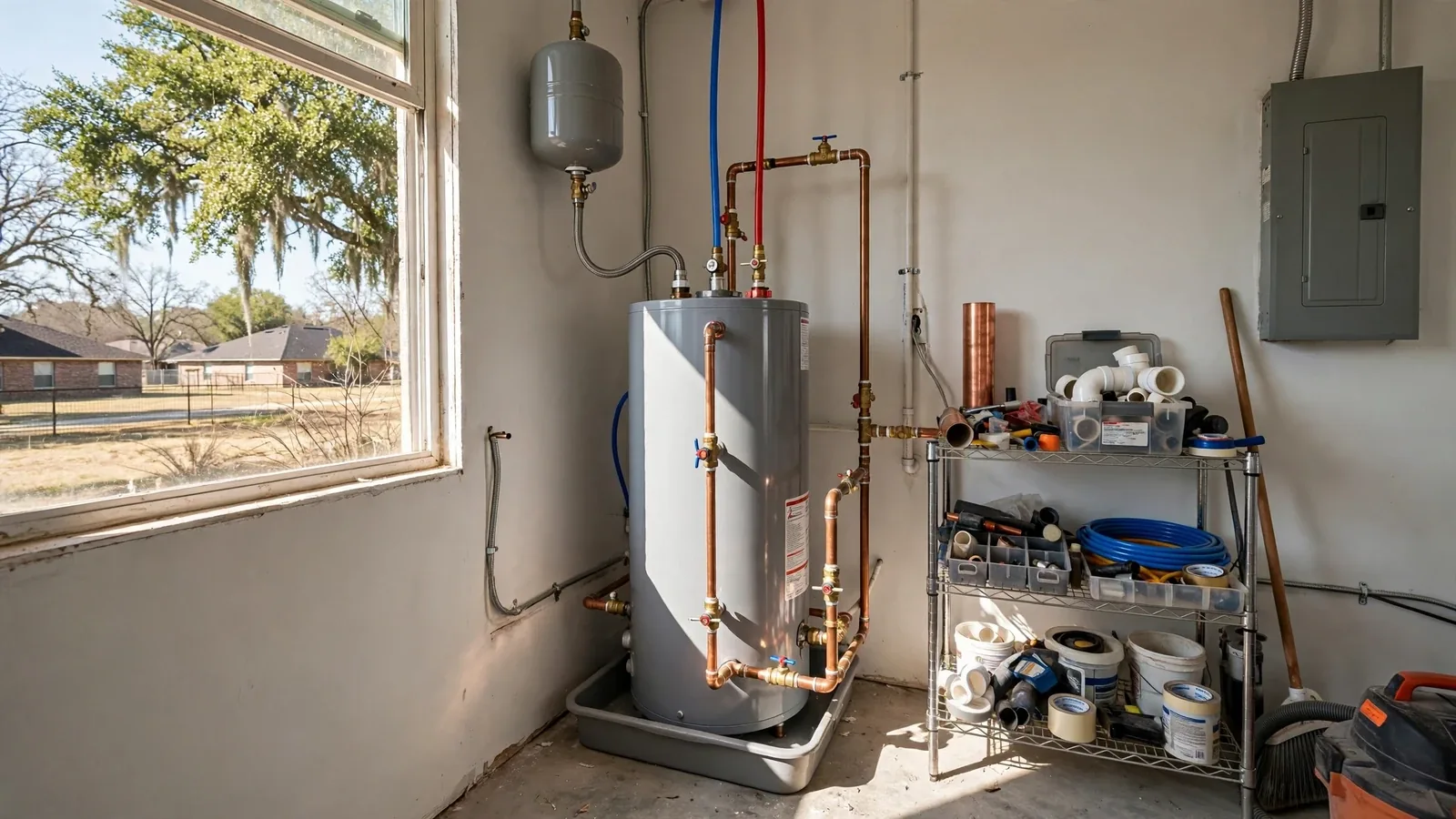
The honest answer up front
People try to install water heaters themselves to save money, and the job looks like swapping two pipes and a connection. In reality, it involves gas or high-amperage electrical work, venting, pressure relief and a heavy tank. A mistake can produce carbon monoxide, a gas leak, a scald or a flood.
In Massachusetts, there is also a legal angle. Plumbing and gas work requires a licensed professional, and permits are issued only to licensed plumbers. That changes the question from whether you can do it to whether you are allowed to.
What the job actually involves
Draining and removing the old tank is the easy part. It is heavy, and it often sits in a tight basement or closet. Then comes shutting off and disconnecting water, gas or electric supply, and the vent. The new unit has to be set level, connected, filled and checked for leaks.
Shut off
Close the water, then the gas or power at the source.
Drain and disconnect
Empty the tank and remove old connections and vent.
Set and connect
Place the new tank, then connect water, fuel and vent.
Fill and test
Fill before powering up, then test for leaks and combustion.
Inspect
Have the work inspected as required locally.
Where DIY goes wrong
None of these show up as a problem on day one. They show up later, as a smell, a leak, a failed unit or an insurance claim that gets denied because the work was unpermitted.
| Mistake | What can happen |
|---|---|
| Wrong vent size or slope | Exhaust gases, including carbon monoxide, enter the home |
| Loose or untested gas fitting | A gas leak and a risk of fire or explosion |
| Missing or wrong relief valve line | Scalding discharge or a ruptured tank |
| Powering up an empty tank | Burned-out elements and damaged unit |
| No expansion tank where needed | Pressure spikes that damage the heater and fixtures |
What to do before you start anything
If you decide to look at a water heater yourself, these safety steps come first. They are not a substitute for a licensed plumber on gas, venting or permitted work.
- Turn off the power at the breaker or the gas at the shutoff before touching the unit.
- Close the cold water supply valve to the heater.
- Let hot water cool before opening any valve.
- Do not work on gas lines or venting. In Massachusetts that is licensed work.
- If anything smells like gas, leave and call 911.
Gas vs electric changes the risk
Electric heaters carry less combustion risk, but the wiring is high amperage and must match the unit and the breaker. A bad connection can overheat and start a fire. Gas heaters add combustion, venting and a gas line, and these are the parts that cause carbon monoxide poisoning when they go wrong.
Either way, a carbon monoxide alarm near the sleeping area and near the heater is a basic safeguard. Do not assume that an installation without symptoms is a safe one.
Sandwich details: permits, inspections and licenses
The Town of Sandwich asks you to contact the Building Department before beginning any construction, renovation or installation work. The department handles plumbing and gas, with permits available online through the Permit Eyes portal. Plumbing and gas inspections are held on Mondays, Wednesdays and Fridays, booked by phone the day before or the same day until 9:00 am, with no set appointment times. Ask the Sandwich Building Department whether your specific job needs a permit.
At the state level, the Board of State Examiners of Plumbers and Gas Fitters licenses master and journeyman plumbers. Permits for plumbing work are issued only to licensed plumbers, and the local inspector must issue the permit before work begins. The plumbing code is 248 CMR 10.00. You can verify any plumber's license through the state's eLIPSE portal.
If you live in a neighboring town, the rules come from that town's building department. We serve Barnstable and Mashpee as well, and each has its own office.
Source: Town of Sandwich Building Department and Mass.gov plumbers and gas fitters board
Want it done right and permitted?
Call for a clear price and a same-day appointment when one is available.
What a professional install covers
A licensed plumber pulls the permit, sizes the heater to your household and checks that the venting, relief valve and expansion tank are correct. They haul away the old tank, test for leaks and combustion, and make sure the work passes inspection.
That paperwork matters later. Insurers and home buyers ask whether major work was permitted, and a clean record avoids arguments. See our water heater replacement page for how we handle an urgent swap.
Questions to ask any installer
Whether you hire us or someone else, a few questions separate careful installers from careless ones. Ask who pulls the permit and who schedules the inspection. Ask what size and type of heater they recommend for your household and why. Ask whether the price includes venting changes, a new expansion tank, a drain pan and removal of the old tank.
Ask what happens if the inspection finds a problem. A professional should fix it at no surprise charge, because the work has to meet code. Finally, ask how the unit is warrantied and who you call if it fails. Answers that are specific and calm are a good sign. Answers that are vague or hurried are not.
If you still want to be involved
You can help without doing the regulated work. Clear the space around the old heater, know where your shutoff valves are, and decide in advance on tank size and fuel type. Ask about high-efficiency options and tankless units, but also about the cost of venting changes.
Compare what each choice costs over its lifetime, not only at the register. A heater that is cheap to buy but expensive to run is not a bargain.
Keep the paperwork afterward. Save the permit, the inspection sign-off, the receipt and the warranty card in one folder. If you sell the home, those papers answer a buyer's questions quickly, and if the heater ever fails early, they show the unit was installed and registered properly.
Also think about where the old tank goes. A full-size tank is heavy and awkward on stairs, and many transfer stations and scrap yards have their own rules for appliances. Hauling it away is part of what a professional install includes, and it is easy to underestimate when you plan to do the job alone on a weekend afternoon.
Frequently asked questions
Plumbing and gas work requires a licensed professional, and permits are issued only to licensed plumbers. Ask your local building department about any exceptions.
Ask the Sandwich Building Department. The town asks you to contact it before beginning any installation work.
Use the state's eLIPSE portal or call the Board of State Examiners of Plumbers and Gas Fitters.
For gas units, carbon monoxide from bad venting, and gas leaks. For all types, scalding and flooding from poor connections.
Often yes, when the unit is available and the site is straightforward. A plumber can confirm same-day availability when you call.
Plumbing and gas inspections are on Mondays, Wednesdays and Fridays, booked by phone with no set times.
Still have a question about your situation? The line is open around the clock.
Call (508) 389-4045Standards note: in Massachusetts, plumbing permits are issued only to licensed plumbers, and the state plumbing code is 248 CMR 10.00. Verify licenses through the Board of State Examiners of Plumbers and Gas Fitters and ask the Town of Sandwich about inspections.