What a garbage disposal installation actually includes
Most people picture a disposal as a single appliance that bolts under the sink. In practice the job has four parts: removing the old unit or the plain sink strainer, mounting the new flange, hanging the grinder body, and connecting both the drain and the power. Each part has its own ways to go wrong, and a mistake in any one of them shows up as a leak or a hum that never turns into grinding.
The good news is that a straightforward swap of one disposal for another of the same brand often goes quickly. The harder case is a first-time installation, where the sink has never had a disposal, there may be no outlet under the cabinet, and the drain layout was never meant to carry the extra bulk of the unit.
Pick the right disposal before you buy
Horsepower is the number on the box, but the features around it matter more for a household kitchen. A larger motor grinds faster and jams less, while a basic unit can stall on fibrous scraps. Continuous feed models run while the switch is on. Batch feed models only run when the stopper is seated, which many families prefer around children.
Check the mounting style as well. A three bolt mount is more secure and quieter than the older snap ring style, and it is the one a plumber will usually reach for. Measure the cabinet depth and make sure the unit hangs clear of the trap and any water filter or hot water dispenser plumbed under the sink.
| Motor class | Typical use | What to expect |
|---|---|---|
| Entry level, about one third to one half horsepower | One or two people, light scraps | Slower grinding, more likely to jam on stringy food |
| Mid range, about three quarters horsepower | Most family kitchens | Good balance of noise, speed and price |
| Heavy duty, one horsepower or more | Large households, frequent cooking | Faster, quieter, needs more cabinet room |
Tools and parts that make the job go smoothly
Gather everything before the old unit comes out. A disposal swap done with half the parts on the counter turns into a late night run to the hardware store with the sink in pieces. Plumber's putty, a new drain gasket, a dishwasher drain connector if you have one, and a power cord kit are the items people forget most often.
- Screwdrivers, a hammer or mallet, and a pair of channel lock pliers
- Plumber's putty for the sink flange, never silicone caulk on the flange seat
- A power cord or the right cable clamp, unless the unit hardwires to a junction box
- A bucket and rags, because the trap always holds more water than you expect
- A flashlight, since the space under a Cape kitchen sink is rarely well lit
Step by step: how the installation goes
Start by switching off the power at the panel, not just at the wall switch. Then clear the cabinet, disconnect the drain pieces, and remove the old unit. If you are fitting a disposal where there was none, take out the sink strainer by loosening the large nut beneath the sink and cleaning the old putty from the opening.
Seat the flange
Roll a rope of plumber's putty and set it under the new flange, then press the flange into the sink opening so a thin bead squeezes out.
Mount the unit
Attach the mounting ring and snap or bolt the grinder body up to it. Rotate until the discharge outlet lines up with the drain.
Connect the drain
Fit the discharge tube with its gasket, then reconnect the trap. If a dishwasher drains into the disposal, knock out the plug inside the inlet first.
Wire and test
Connect the cord or hardwire to the junction box, restore power, run water, then check every joint with a dry paper towel.
The knockout plug mistake
The dishwasher inlet on a new disposal has a small plastic plug. If it stays in place, the dishwasher cannot drain, and the water backs up into the dishwasher tub. Remove it with a screwdriver and fish the plug out of the disposal chamber before you finish.
Would you rather leave it to a plumber?
A disposal installation touches plumbing and wiring in the same cabinet. The line is open around the clock if you want a licensed plumber to take it on.
Where do-it-yourself disposal installs go wrong
Leaks at the flange are the most common failure. Either the putty was too thin, or the nut was tightened unevenly and the flange sat crooked. A slow weep at the flange often looks like a leak somewhere else, because the water runs down the outside of the unit and drips from the lowest point.
The second common failure is a poor drain slope. If the trap arm tilts the wrong way, scraps settle and the sink backs up in weeks. The third is electrical. A disposal needs its own protected circuit in many homes, and a cord that is too short or a loose connection inside the junction box is a safety issue, not an inconvenience.
Common do-it-yourself results
- A flange leak that appears a day or two later
- A trap that traps water but sags
- A unit that hums and does not turn
- A cord strung across the cabinet
What a plumber checks for
- A sealed flange tested with water standing in the sink
- A trap arm pitched toward the drain
- Free rotation of the grinder plate before power goes back on
- A clean, clamped power connection
Sandwich specifics: permits, inspections and your drain
In Sandwich, the Building Department handles plumbing and gas permits and inspections, and its page asks residents to contact it before beginning any construction, renovation or installation work. It does not list which jobs need a permit, so the safe move is to call the Building Department and ask whether a disposal swap on your house needs one.
Massachusetts also restricts who can pull plumbing permits. State rules say permits for plumbing work are issued only to licensed plumbers, and the local plumbing inspector must issue the permit before the work starts. The Uniform State Plumbing Code is 248 CMR 10.00. That is a real reason to confirm with the town before you open the cabinet.
There is a second Sandwich question worth asking: where does your kitchen drain go? A disposal adds solids to the waste stream. The Health Department has a Water and Wastewater section, and it is the right place to ask whether your street has sewer or a Title 5 septic system. If your home is on septic, ask a plumber or a septic professional whether a disposal suits your system at all.
Sources: Town of Sandwich Building and Health Departments and Massachusetts Board of State Examiners of Plumbers and Gas Fitters.
When to hire a plumber
Hire a plumber when the sink has no outlet nearby, when you are changing the drain layout, or when you find corroded shutoffs or a rotted cabinet floor once the old unit comes out. In those cases, the plumbing is the real project and the disposal is the last step.
If you are in Bourne or Barnstable and a neighbor recommended a handyman, check the license before you let anyone start. A licensed plumber can pull the permit and stand behind the work, and you can learn more about our garbage disposal repair and installation work if you want the full list of what we handle.
Care habits that keep a new disposal running
Run cold water before, during and for a short time after grinding. Feed scraps in small batches. Skip fibrous items such as celery and corn husks, grease, coffee grounds in volume, and bones. Most stalls trace back to one of those, not to a defective unit.
A disposal that is run daily stays cleaner than one used twice a month. If a smell develops, it is usually trapped food on the underside of the splash guard and not a plumbing fault, so a scrub with a brush solves it.
Frequently asked questions
A like-for-like swap often takes an hour or two. A first-time install that needs a new outlet, drain changes or a repair to the cabinet floor can take much longer.
The Sandwich Building Department does not list which jobs need a permit on its public page, so call the Building Department and ask. State rules say plumbing permits are issued only to licensed plumbers.
Possibly, but it adds solids to the tank. Ask the Sandwich Health Department or a septic professional about your system before you buy one.
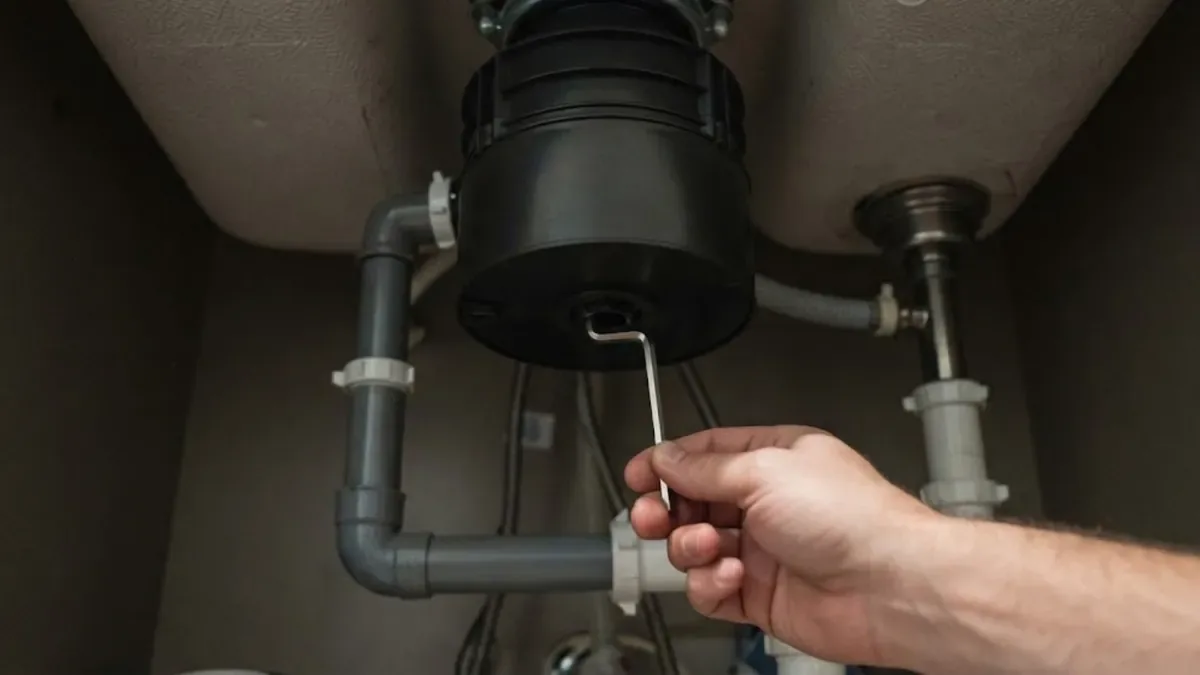
Something is jamming the grinder plate. Switch off the power, use the hex socket in the bottom of the unit to turn it by hand, and remove whatever is stuck.
Yes. The knockout plug must be removed, and the drain line should loop high before it meets the disposal so waste water does not siphon back into the dishwasher.
A mid range unit suits most family kitchens. Pick a heavier model if you cook large meals daily or have limited tolerance for jams.
Still have a question about your situation? The line is open around the clock.
Call (508) 389-4045Standards note: disposal installation connects to the drain system governed by 248 CMR 10.00. See the Town of Sandwich Building Department for permit questions.