How A Tankless Water Heater Works
A tankless heater heats water only when you open a tap. A flow sensor detects the demand, the burner or element fires and the water leaves hot. There is no storage tank to keep warm, which is where the potential energy savings and the compact size come from.
The tradeoff is that the unit must deliver a large amount of heat in a short moment. That is why gas supply, venting and water quality matter far more here than they do with a tank.
What Has To Be Right For An Install
Homes that already have a tank heater often need changes before a tankless unit will run well. We check each of these before quoting.
- Gas line size. Many tankless units draw far more gas than a tank, so an older half-inch line may need upgrading.
- Venting. Tankless units usually use sealed stainless or plastic vent pipe with specific length limits.
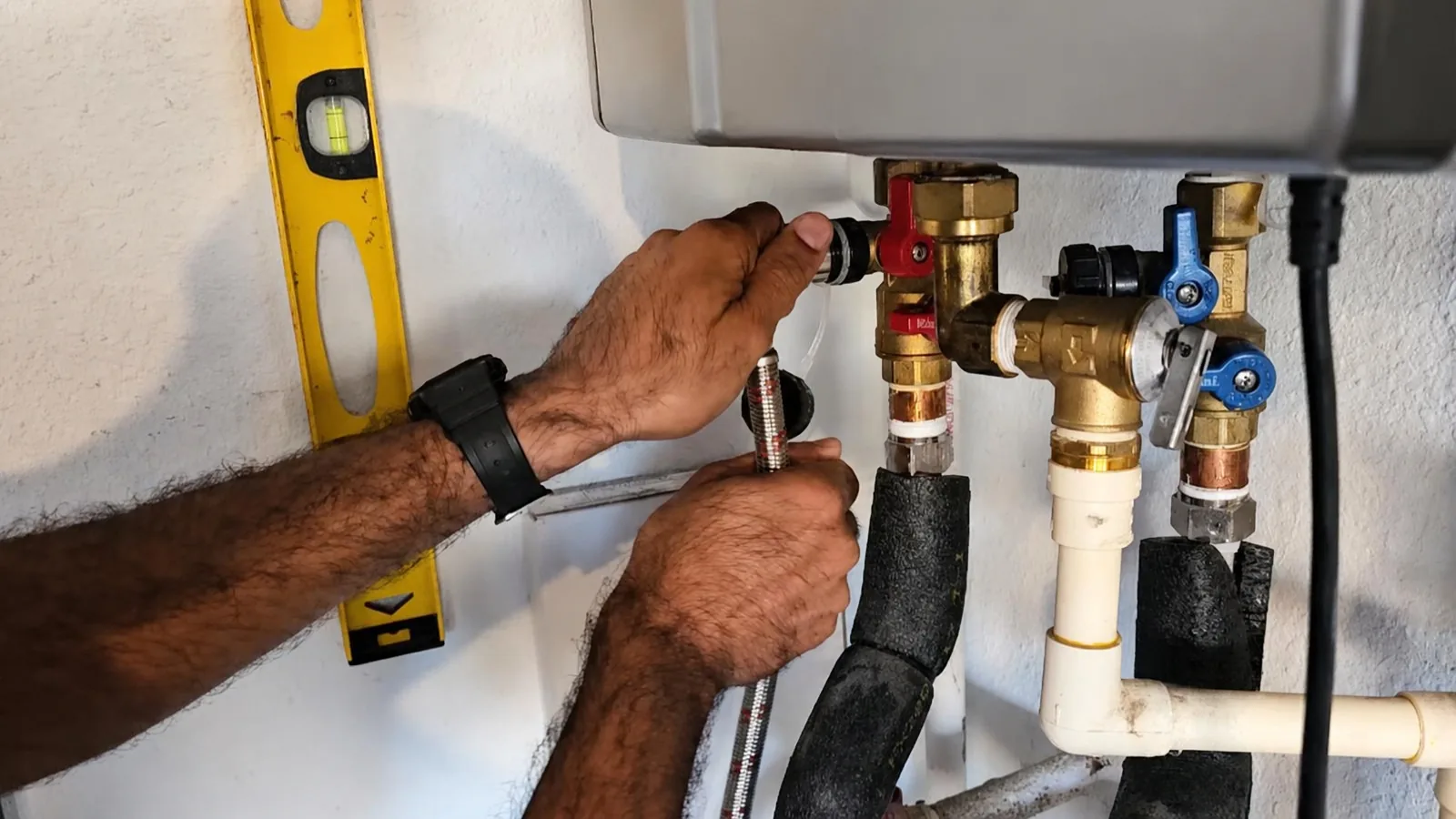
- Water line and shutoffs. Service valves let you flush the unit later without a long job.
- Condensate drain. High-efficiency units produce acidic condensate that must drain correctly.
- Electrical outlet. Most units need power for the controls, fans and igniters.
Flushing And Descaling
Mineral scale builds on the heat exchanger and slowly reduces flow and efficiency. Annual flushing with a descaling solution is the standard care for most tankless units and manufacturers often require it to keep a warranty valid.
A flush takes a pump, hoses and service valves and usually runs for around an hour. If your unit has no service valves, we can add them so future flushes are simple. Skipping the flush is the single most common reason a tankless heater starts throwing error codes.
Common Tankless Problems
These symptoms show up often, and most have a clear cause.
| Symptom | Likely cause | What we check |
|---|---|---|
| Lukewarm water | Scale or a partly blocked inlet filter | Flush the unit and clean the screen |
| Error code and shutdown | Vent, ignition or flame sensor fault | Read the code and test the component |
| Cold sandwich between hot bursts | Low flow below the activation level | Check aerators, valves and flow rate |
| No hot water at all | Gas supply, power or a tripped safety | Test supply and controls |
When A Tankless Heater Is Not The Right Move
A tankless unit is not always the best answer. A small home with low hot water use may never earn back the added install cost. A property with long, uninsulated pipe runs will still wait for hot water to arrive.
We will say so if a tank or a hybrid makes more sense. For a standard swap, see our water heater installation page. If your tankless unit has failed and you have no hot water, our water heater repair team handles urgent calls.
Sandwich Water And Scale
Sandwich Water District supplies the town, and its 2025 report lists sodium hydroxide for corrosion control along with a lead 90th percentile of 0 ppb. The report does not publish hardness, so we do not assume your scale level.
What we do see is the result inside the unit. When we open a heat exchanger or inspect a flush, the condition tells us whether yearly service is enough or whether a water treatment step should be discussed.
Source: Sandwich Water District 2025 Consumer Confidence Report.
What Drives The Price Of Tankless Work
What shapes the price
You get a clear price before work starts. Tankless projects vary more than tank swaps, and these are the reasons.
Unit capacity
Larger homes with several bathrooms need higher flow rates and a more capable unit.
Gas line upgrade
Increasing line size is often the biggest added item on a conversion.
Venting changes
New vent pipe and wall or roof penetrations add materials and labor.
Service valves and flush
Valves are a small cost that saves money on every future flush.
Condensate and electrical
Drain routing and an outlet, if missing, are included in the scope.
Frequently asked questions
Many manufacturers call for a flush once a year. Homes with heavy scale may need it more often. We set a schedule based on what we find inside the unit.
Sometimes, but many older homes need a larger line. We measure the run and the load before we recommend a model.
Codes point to venting, ignition, flame sensing or water flow problems. Bring the code number when you call and we can narrow it down quickly.
Yes. We diagnose and repair most common brands, though parts availability depends on the model.
It depends on usage, fuel costs and your current unit's age. We will tell you plainly if a tank makes more sense.
Many models run on propane with a conversion kit or a propane-ready version. We confirm the setup before installing.
Still have a question about your situation? The line is open around the clock.
Call (508) 389-4045Standards note: tankless units are installed to manufacturer guidelines and the state code, 248 CMR 10.00, including venting and gas sizing where applicable.